

Top libraries for Distributed Deep Learning
Posted on September 21st, 2018
 Posted by Packt Publishing on June 13, 2018 at 12:30am
The performance of the neural network improves with an increasing volume of training data. With more and more devices generating data that can potentially be used for training and model generation, the models are getting better at generalizing the stochastic environment and handling complex tasks. However, with more data and more complex structures for the deep neural networks, the computational requirements increase.
Even though we have started leveraging GPUs for deep neural network training, the vertical scaling of the compute infrastructure has its own limitations and cost implications. Leaving the cost implications aside, the time it takes to train a significantly large deep neural network on a large set of training data is not reasonable. However, due to the nature and network topology of the neural networks, it is possible to distribute the computation on multiple machines at the same time and merge the results back with a centralized process. This is very similar to Hadoop, as a distributed computing batch processing engine, and Spark, as an in-memory distributed computing framework.
With deep neural networks, there are two approaches for leveraging distributed computing:
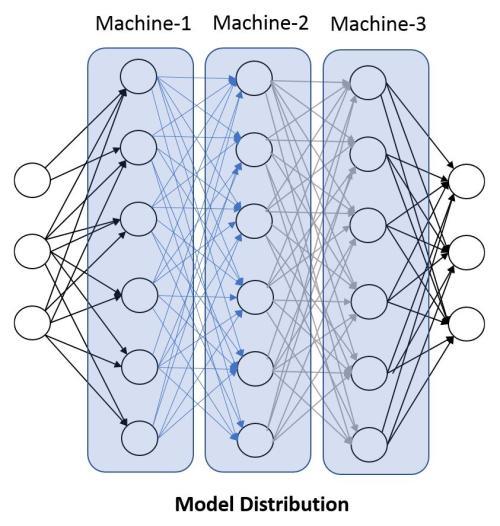
- Model Distribution: In this approach, the deep neural network is broken into logical fragments that are treated as independent models from a computational perspective. The results from these models are combined by a central process, as depicted in this diagram:
- Data Distribution: In this approach, the entire model is copied to all the nodes participating in the cluster and the data is distributed in chunks for processing. The master process collects the output from the individual nodes and produces the final outcome, shown as follows:
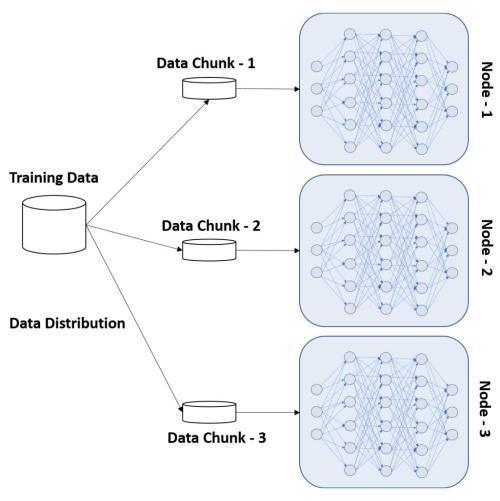
The data distribution approach is very similar to Hadoop’s MapReduce framework. The MapReduce job creates the input splits based on predefined and run-time configuration parameters. These chunks are sent to the independent nodes for processing by the map tasks in a parallel manner.
The output from the map tasks is shuffled for relevance (simple sort) and is given as input to the reduce tasks for generating intermediate results. The individual MapReduce chunks are combined to produce the final result. The data distribution approach is more naturally suitable for Hadoop and Spark frameworks and it is a more widely researched approach at this time. The deep neural networks that leverage data distribution primarily deploy a parameter-averaging strategy for training the model.
This is a simple but efficient approach for training a deep neural network with data distribution:
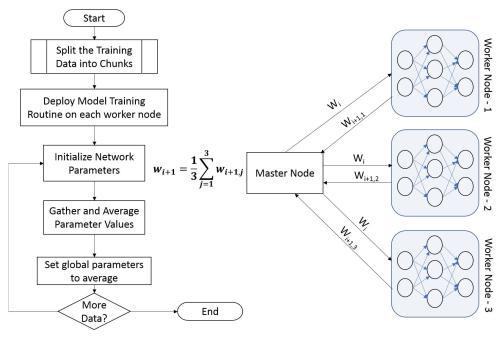
Based on these fundamental concepts of distributed processing, let’s review some of the popular libraries and frameworks that enable parallelized deep neural networks.
Distributed deep learning
With an ever-increasing number of data sources and data volumes, it is imperative that the deep learning application and research leverage the power of distributed computing frameworks. In this section, we will review some of the libraries and frameworks that effectively leverage distributed computing. These are popular frameworks based on their capabilities, adoption level, and active community support.
DL4J and Spark
The core framework of DL4J is designed to work seamlessly with Hadoop (HDFS and MapReduce) as well as Spark-based processing. It is easy to integrate DL4J with Spark. DL4J with Spark leverages data parallelism by sharding large datasets into manageable chunks and training the deep neural networks on each individual node in parallel. Once the models produce parameter values (weights and biases), those are iteratively averaged for producing the final outcome.
API overview
In order to train the deep neural networks on Spark using DL4J, two primary wrapper classes need to be used:
- SparkDl4jMultiLayer: A wrapper around DL4J’s MultiLayerNetwork
- SparkComputationGraph: A wrapper around DL4J’s ComputationGraph
The network configuration process for the standard, as well as the distributed, mode remains same. That means we configure the network properties by creating a MultiLayerConfiguration instance. The workflow for deep learning on Spark with DL4J can be depicted as follows:
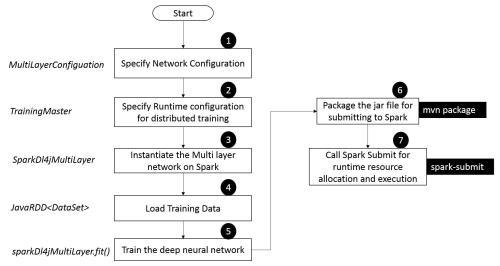
Here are the sample code snippets for the workflow steps:
- Multilayer network configuration:
MultiLayerConfiguration conf = new NeuralNetConfiguration.Builder()
.optimizationAlgo(OptimizationAlgorithm.STOCHASTIC_GRADIENT_DESCENT).iterations(1)
.learningRate(0.1)
.updater(Updater.RMSPROP) //To configure: .updater(new RmsProp(0.95))
.seed(12345)
.regularization(true).l2(0.001)
.weightInit(WeightInit.XAVIER)
.list()
.layer(0, new GravesLSTM.Builder().nIn(nIn).nOut(lstmLayerSize).activation(Activation.TANH).build())
.layer(1, new GravesLSTM.Builder().nIn(lstmLayerSize).nOut(lstmLayerSize).activation(Activation.TANH).build())
.layer(2, new RnnOutputLayer.Builder(LossFunctions.LossFunction.MCXENT).activation(Activation.SOFTMAX) //MCXENT + softmax for classification
.nIn(lstmLayerSize).nOut(nOut).build())
.backpropType(BackpropType.TruncatedBPTT).tBPTTForwardLength(tbpttLength).tBPTTBackwardLength(tbpttLength)
.pretrain(false).backprop(true)
.build();
- Set up the runtime configuration for the distributed training:
ParameterAveragingTrainingMaster tm = new ParameterAveragingTrainingMaster.Builder(examplesPerDataSetObject)
.workerPrefetchNumBatches(2) //Async prefetch 2 batches for each worker
.averagingFrequency(averagingFrequency)
.batchSizePerWorker(examplesPerWorker)
.build();
- Instantiate the Multilayer network on Spark with TrainingMaster:
SparkDl4jMultiLayer sparkNetwork = new SparkDl4jMultiLayer(sc, config, tm);
- Load the shardable training data:
public static JavaRDD<DataSet> getTrainingData(JavaSparkContext sc) throws IOException {
List<String> list = getTrainingDatAsList(); // arbitrary sample method
JavaRDD<String> rawStrings = sc.parallelize(list);
Broadcast<Map<Character, Integer>> bcCharToInt = sc.broadcast(CHAR_TO_INT);
return rawStrings.map(new StringToDataSetFn(bcCharToInt));
}
- Train the deep neural network:
sparkNetwork.fit(trainingData);
- Package the Spark application as a .jar file:
mvn package
- Submit the application to Spark runtime:
spark-submit –class fully qualified class name>> –num-executors 3 ./jar_name>>-1.0-SNAPSHOT.jar
The DeepLearning4j official website provides extensive documentation for running the deep neural networks on Spark: https://deeplearning4j.org/spark
TensorFlow
TensorFlow is the most popular library created and open sourced by Google. It uses data-flow graphs for numerical computations and deals with Tensor as the basic building block. A Tensor can simply be considered as an n-dimensional matrix. TensorFlow applications can be seamlessly deployed across platforms and it can run on GPUs and CPUs, along with mobile and embedded devices. TensorFlow is designed as a large-scale distributed training that supports new machine learning models, research, and granular-level optimizations.
TensorFlow is quick to install and start experimenting with. The latest version of TensorFlow can be downloaded from https://www.tensorflow.org/. The site also contains extensive documentation and tutorials.
Further reading:
Distributed TensorFlow: Working with multiple GPUs and servers
Keras
Keras is a high-level neural network API, written in Python and capable of running on top of TensorFlow. For more information, refer to https://keras.io/.
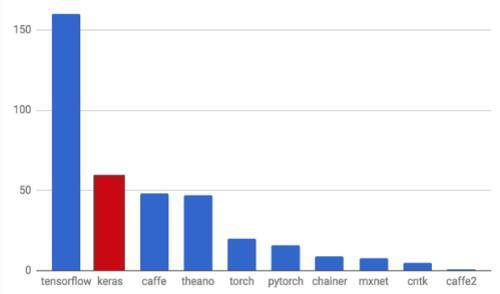
TensorFlow and Keras hold the top two spots in terms of adoption and mention by researchers in scientific papers. The stack ranking of the frameworks and libraries as per arxiv.org is as follows:
You enjoyed an excerpt from Packt Publishing’s latest book, Artificial Intelligence for Big Data written by Anand Deshpande and Manish Kumar. If you are a Java developer, this is the book you will need to build next-generation Artificial Intelligence systems.
Content retrieved from: https://www.datasciencecentral.com/profiles/blogs/top-libraries-for-distributed-deep-learning.
Python Deep Learning tutorial: Create a GRU (RNN) in TensorFlow
Posted on September 17th, 2018
 Posted by Capri Granville on January 27, 2018 at 7:00pm
Guest blog post by Kevin Jacobs.
MLPs (Multi-Layer Perceptrons) are great for many classification and regression tasks. However, it is hard for MLPs to do classification and regression on sequences. In this Python deep learning tutorial, a GRU is implemented in TensorFlow. Tensorflow is one of the many Python Deep Learning libraries.
By the way, another great article on Machine Learning is this article on Machine Learning fraud detection. If you are interested in another article on RNNs, you should definitely read this article on the Elman RNN.
What is a GRU or RNN?
A sequence is an ordered set of items and sequences appear everywhere. In the stock market, the closing price is a sequence. Here, time is the ordering. In sentences, words follow a certain ordering. Therefore, sentences can be viewed as sequences. A gigantic MLP could learn parameters based on sequences, but this would be infeasible in terms of computation time. The family of Recurrent Neural Networks (RNNs) solve this by specifying hidden states which do not only depend on the input, but also on the previous hidden state. GRUs are one of the simplest RNNs. Vanilla RNNs are even simpler, but these models suffer from the Vanishing Gradient problem.
[responsive_video type=’youtube’ hide_related=’1′ hide_logo=’0′ hide_controls=’0′ hide_title=’0′ hide_fullscreen=’0′ autoplay=’0′]https://www.youtube.com/watch?v=dFARw8Pm0Gk[/responsive_video]
Mathematical GRU Model
The key idea of GRUs is that the gradient chains do not vanish due to the length of sequences. This is done by allowing the model to pass values completely through the cells. The model is defined as the following [1]:




I had a hard time understanding this model, but it turns out that it is not too hard to understand. In the definitions, 


The Task: Adding Numbers
In the code example, a simple task is used for testing the GRU. Given two numbers 


![a = [0, 1, 1]](https://s0.wp.com/latex.php?latex=a+%3D+%5B0%2C+1%2C+1%5D&bg=ffffff&fg=000000&s=0)
![b = [0, 0, 1]](https://s0.wp.com/latex.php?latex=b+%3D+%5B0%2C+0%2C+1%5D&bg=ffffff&fg=000000&s=0)
![a = [1, 1, 0]](https://s0.wp.com/latex.php?latex=a+%3D+%5B1%2C+1%2C+0%5D&bg=ffffff&fg=000000&s=0)
![b = [1, 0, 0]](https://s0.wp.com/latex.php?latex=b+%3D+%5B1%2C+0%2C+0%5D&bg=ffffff&fg=000000&s=0)
![c = [0, 0, 1]](https://s0.wp.com/latex.php?latex=c+%3D+%5B0%2C+0%2C+1%5D&bg=ffffff&fg=000000&s=0)
![[1, 0, 0]](https://s0.wp.com/latex.php?latex=%5B1%2C+0%2C+0%5D&bg=ffffff&fg=000000&s=0)

The Code
The code is self-explaining. If you have any questions, feel free to ask! The code can also be found on GitHub. Sharing (or Starring) is Caring :-)!
Results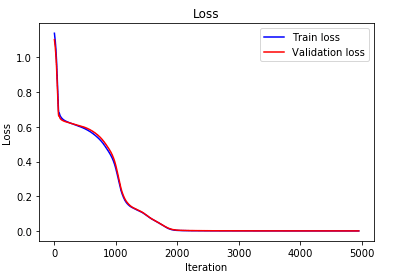
After ~2000 iterations, the model has fully learned how to add 2 integer numbers!
Conclusion (TL;DR)
This Python deep learning tutorial showed how to implement a GRU in Tensorflow. The implementation of the GRU in TensorFlow takes only ~30 lines of code! There are some issues with respect to parallelization, but these issues can be resolved using the TensorFlow API efficiently. In this tutorial, the model is capable of learning how to add two integer numbers (of any length).
To access the source code and view the original article, click here.
DSC Resources
- Services: Hire a Data Scientist | Search DSC | Classifieds | Find a Job
- Contributors: Post a Blog | Ask a Question
- Follow us: @DataScienceCtrl | @AnalyticBridge
Popular Articles
- Difference between Machine Learning, Data Science, AI, Deep Learnin…
- What is Data Science? 24 Fundamental Articles Answering This Question
- Hitchhiker’s Guide to Data Science, Machine Learning, R, Python
- Advanced Machine Learning with Basic Excel
Content retrieved from: https://www.datasciencecentral.com/profiles/blogs/gru-implementation-in-tensorflow.
10 Best Data Science Certification, Course & Tutorial [2018 UPDATED]
Posted on September 7th, 2018
Our team of global experts have done extensive research to come up with this list of 10 Best Data Science Certifications, Degree, Course, Tutorial and Training available Online for 2018. These include free and paid learning resources and are relevant for beginners, intermediate learners as well as experts.
Contents
- 1. Data Science Course A-Z™: Real-Life Data Science (Udemy)
- 2. Python for Data Science and Machine Learning Course
- 3. Machine Learning Certification by Stanford University (Coursera)
- 4. Microsoft Professional Program in Data Science (edX)
- 6. Tableau 10 A-Z: Hands-On Tableau Training For Data Science!
- 7. Applied Data Science with Python Certification (University of Michigan)
- 8. Data Science Certification from John Hopkins University (Coursera)
- 9. Master of Computer Science in Data Science Degree Online (Illinois)
- 10. Data Science, Deep Learning, & Machine Learning with Python
- 11. Data Science: Deep Learning Tutorial in Python
- 12. Data Science Tutorial with R
1. Data Science Course A-Z™: Real-Life Data Science (Udemy)
Kirill Eremenko is a Data Science management consultant who helps businesses drive strategy, revamp customer experience and revolutionize existing operational processes. He has created 36 online courses so far and has taught over 400,000 students! At an average rating of 4.5 from 96,000 students you can be rest assured that he is one of the best tutors in the business. In this course he will teach you Data Science step by step through real Analytics examples including training you on Data Mining, Modeling, Tableau Visualization and more. Specifically you will learn about cleaning and preparing your data, performing basic visualization, modelling your data using tools such as SQL, SSIS, Tableau and Gretl. This is one of the Best Data Science tutorial you will find online and you will receive a certificate on completion.
[responsive_video type=’youtube’ hide_related=’1′ hide_logo=’0′ hide_controls=’0′ hide_title=’0′ hide_fullscreen=’0′ autoplay=’0′]https://www.youtube.com/watch?v=-hFBAC0D5tw[/responsive_video]
Rating : 4.5 out of 5
Review : It has been a great learning curve. I understood most things Kirill taught ( the question is do I remember them? hahaha!) Jokes apart, I honestly think he did a very good job at explaning all concepts particularly the tough mathematical/statistical contents. Well done! Kirill. I will be rewatching some of the videos again to refresh my memory. Overall it’s great value for money! Thanks Kirill for sharing your knowledge.
2. Python for Data Science and Machine Learning Course
This comprehensive course by Jose Portilla, a BS and MS in Engineering from Santa Clara University will help you understand how to use Python to analyze data, create beautiful visualizations and use powerful machine learning algorithms. Learn all about NumPy, Seaborn , Matplotlib, Pandas, Scikit-Learn, Machine Learning, Plotly, Tensorflow and much more in this 21.5 hour long tutorial which has already been attended by over 100,000 students globally. With high ratings and wonderful recommendations, this is a must attend program if you are looking to master the subject.
[responsive_video type=’youtube’ hide_related=’1′ hide_logo=’0′ hide_controls=’0′ hide_title=’0′ hide_fullscreen=’0′ autoplay=’0′]https://www.youtube.com/watch?v=bwtXJKg7OTY[/responsive_video]
Rating : 4.6 out of 5
Review : The best instructor i have ever seen and the Question and Answer forum has an immediate response. i love his teachings. Thank you sir. But i would like to suggest in MNIST lecture. i watched thrice, but i couldnt understand those 3 lectures, please update those lectures. but at the end, contriblearn made me satisfied. i was very confused about tensorflow. but in the end, i completely understood. hope you continue your lecture series. i want to learn more courses from you. – Chennakeshav Rao K
3. Machine Learning Certification by Stanford University (Coursera)
Andrew Ng, former head of Google Brain and Baidu AI Group has created this course along with other professors from Stanford University. It is one of the most sought after courses and certifications around machine learning available online. You will learn about Supervised learning, Unsupervised learning among other key areas and the course includes multiple case studies and applications to help you learn how to apply algorithms to build smart robots. This is one of the best data science certification you can opt for.
Rating : 4.9 out of 5
Review : This course is arguably the best place to start for anyone who wants to learn machine learning. I’ve tried other approaches before, like diving head first into neural networks without a clue about other simpler algorithms like linear and logistic regression and just got confused despite having no trouble with the mathematics. This course however made everything crystal clear. And I have yet to see an instructor as good as Andrew Ng. His enthusiasm was a great motivator.
4. Microsoft Professional Program in Data Science (edX)
This professional program by Microsoft consists of 9 courses in addition to a project and will take about 16 – 32 hours per course. It is a 10 course program and you can also choose individual courses if you want. You will learn about using Microsoft Excel to explore data, using Transact-SQL to query a relational database, creating data models using Excel or Power BI, applying statistical methods to data and using R or Python to explore and transform data Follow a data science methodology. The program is broken into 4 major units which further consist 10 courses. It is all followed by a project to help you apply all that you learn through the duration of this course.
Rating : 4.5 out of 5
5. Machine Learning Course A-Z™: Hands-On Python & R In Data Science
Kirill Eremenko and Hadelin de Ponteves along with their Super DataScience Team are masters when it comes to data science and they have together come up with this brilliant course to help you create Machine Learning Algorithms in Python and R. You don’t need any prior experience before signing up for this course and high school level mathematics understanding will be enough. It is a 40.5 hour long offering that will give you all knowledge required to excel in this field and has already been attended by more than 200,000 students worldwide.
[responsive_video type=’youtube’ hide_related=’1′ hide_logo=’0′ hide_controls=’0′ hide_title=’0′ hide_fullscreen=’0′ autoplay=’0′]https://www.youtube.com/watch?v=p317nw5Fj3o[/responsive_video]
Rating : 4.5 out of 5
Review : Kirill and Hadelin really took time to design the course such a way that understand the Concept very easily, even though if you don’t have any previous knowledge. On Top of it , specially having perfectly designed templates for various algorithms will make you feel very comfortable . Throughout the course if you follow the video , you are sure to get the concept of machine learning. And at the end of the course I’m quite confident to face any challenge in Machine learning world . – Prantik Bala
6. Tableau 10 A-Z: Hands-On Tableau Training For Data Science!
Kirill Eremenko, the Data Scientist & Forex Systems Expert has another wonderful course lined up and this time it is about Tableau 10. He will teach you data visualization through Tableau 10 and teach you all about customer purchase behavior and sales trends. He will empower you to prepare and present data easily.
[responsive_video type=’youtube’ hide_related=’1′ hide_logo=’0′ hide_controls=’0′ hide_title=’0′ hide_fullscreen=’0′ autoplay=’0′]https://www.youtube.com/watch?v=q03vxIt2BkM[/responsive_video]
Rating : 4.7 out of 5
Review : All of Kirill’s courses are awesome, and this one is no exception. I already knew how to use Python and R for data science, but this course got me very excited in Tableau! I would love to use Tableau for most data science visualizations from now on – possibly excepting machine learning visualizations, since Tableau cannot train machine learning models AFAIK (although it can forecast).
7. Applied Data Science with Python Certification (University of Michigan)
This is a 5 course program from the University of Michigan which will help you learn data science through the python programming language. You will need to have basic knowledge of Python and will be taught about popular python toolkits such as pandas, matplotlib, nltk and networkx among others to make sense of data. In particular, the 5 courses will cover Applied Plotting, Charting & Data Representation in Python, Applied Machine Learning in Python, Applied Text Mining in Python and Applied Social Network Analysis in Python. You will be taught by Christopher Brooks, Kevyn Collins-Thompson, Daniel Romero and V. G. Vinod Vydiswaran.
[responsive_video type=’youtube’ hide_related=’1′ hide_logo=’0′ hide_controls=’0′ hide_title=’0′ hide_fullscreen=’0′ autoplay=’0′]https://www.youtube.com/watch?v=lFpcZKBUiSY[/responsive_video]
Rating : 4.5 out of 5
Review : Great class! Right amount of challenging for someone with some Python (or scripting) background to cover some useful Pandas scenarios. Only critique is the coding challenges would be better if error logs were provided.
8. Data Science Certification from John Hopkins University (Coursera)
This certification course from John Hopkins will help you launch your Data Science career. It consists of a nine course introduction to data science, developed and taught by leading professors including Roger D. Peng, PhD Associate Professor, Biostatistics; Brian Caffo, PhD and Jeff Leek, PhD Associate Professor, Biostatistics. In this program, you will learn about R Programming, Getting and Cleaning Data, Exploratory Data Analysis, Reproducible Research and Statistical Inference among host of other areas. The training will be followed by a Capstone Project, where you will build a data product using real-world data. Our team of experts feels that this is one of the best Data Scientist certification you will find on the web.
Rating : 4.5 out of 5
Review : The Professor’s are just amazing in their knowledge. The slow bits of information and the way testing is done is so methodical and so well planned. If anybody says they are bored then I am sure they are bluffing, as I found out how enjoyable online learning can me. I am 40, working and a father of 2 children, time is scarce and this online way of learning with financial aid, I could not ask for anything more. Coursera is helping people like me find a hope of learning at their own pace, place and with their financial aid program helping poor people from developing countries like India see the light at the end of the tunnel.
9. Master of Computer Science in Data Science Degree Online (Illinois)
This Master of Computer Science in Data Science (MCS-DS) is an Online Degree from Illinois. You will be taught to build expertise data visualization, machine learning, data mining and cloud computing. It is offered in collaboration with the University’s Statistics Department and top-ranked iSchool. Multitude of entrepreneurs, educators, and technical geniuses have graduated from this school. This is one of the few Data Science Degree Courses available online.
[responsive_video type=’youtube’ hide_related=’1′ hide_logo=’0′ hide_controls=’0′ hide_title=’0′ hide_fullscreen=’0′ autoplay=’0′]https://www.youtube.com/watch?v=pJoYt7Yh4z0[/responsive_video]
Rating : 4.5 out of 5
10. Data Science, Deep Learning, & Machine Learning with Python
Frank Kane is an expert at all things data science and with this tutorial, he will teach you all about neural network, artificial intelligence and machine learning techniques. This comprehensive data science tutorial with over 80 lectures includes loads of Python code examples. Frank, with his previous experience at Amazon and IMDb will teach you all about what matters. Specifically, you will learn to make predictions using linear regression, polynomial regression, and multivariate regression; understand complex multi-level models; build a spam classifier and learn much more in 12 hours of on demand online lectures.
[responsive_video type=’youtube’ hide_related=’1′ hide_logo=’0′ hide_controls=’0′ hide_title=’0′ hide_fullscreen=’0′ autoplay=’0′]https://www.youtube.com/watch?v=PWExUJ_di2M[/responsive_video]
Rating : 4.5 out of 5
Review : Excellent explanations. Easy to follow. GREAT examples! This is a phenomenal class and Frank is an extraordinary instructor! I recommend this class / tutorial to all very interested!
11. Data Science: Deep Learning Tutorial in Python
This program will serve as a guide for writing a neural network in Python and Numpy using Google’s TensorFlow. The trainer will teach you about how deep learning really works and how a neural network is built from basic building blocks. He will help you demystify various terms related to neural networks like “activation”, “backpropagation” and “feedforward”. There is a live project which is a part of the course to help you implement what you learn in real time.
[responsive_video type=’vimeo’]https://vimeo.com/162437052[/responsive_video]
Rating : 4.6 out of 5
Review – Very nice course, it is well organized and explained. The exercises and examples are interesting and practical, maybe a bit too easy if an expert. The pace is good and everything covered thoroughly. Extra help lecture provided for troubleshooting.
12. Data Science Tutorial with R
With a BS and MS from Santa Clara University, Jose Marcial Portilla also comes with years of experience as a professional trainer for Data Science and programming. His client base over the years includes General Electric, Cigna, The New York Times, Credit Suisse among many others. In this data science tutorial, he will teach you how to use the R programming language for data science. Few of the topics that will be covered include programming with R, advanced R Features, using R to handle Excel Files, web scraping with R, connecting R to SQL, using ggplot2 for data visualizations and many other areas.
Rating : 4.6 out of 5
Review : Great course, amazing teacher. Although I have a background in software development and databases, I had never used R before or employed statistical methods. After taking this course, including the recommended reading and the exercises, I feel confident in being able to use R and the machine learning methods covered in the course.
Bonus Courses
13. Deep Learning Certification by deeplearning.ai
Learn how to build neural networks and lead successful machine learning projects in this 5 course specialization from deeplearning.ai . You will be taught about Python, Tensor Flow, RNNs, LSTM, Adam, Convolutional Networks and Xavier initialization among other aspects. The program is taught by Andrew Ng, Co-founder, Coursera & Adjunct Professor, Stanford University; Younes Bensouda Mourri, Mathematical & Computational Sciences, Stanford University and Kian Katanforoosh, Adjunct Lecturer at Stanford University, deeplearning.ai, Ecole Centrale Paris. This is one of the most sought after programs on Deep Learning available online.
[responsive_video type=’youtube’ hide_related=’1′ hide_logo=’0′ hide_controls=’0′ hide_title=’0′ hide_fullscreen=’0′ autoplay=’0′]https://www.youtube.com/watch?v=VLQHpvuwsV0[/responsive_video]
Rating : 4.9 out of 5
Review : Very useful course. Gives great insight on the hyper parameter tuning, regularisation and optimisation. One request I have is to provide a docker image which we can use to run the exercises locally. Sometimes I found it hard to build the environment where I can run the coursework. Some of the installations are clashing and it is not clear what versions of libraries are used in the coursework environment. It sometimes requires unnecessary effort.
14. Advanced Machine Learning Certification by Higher School of Economics
A total of 21 professors and researchers have come together to create this course; and this is undoubtedly one of the most comprehensive courses on data science and machine learning. This is an intermediate level course only relevant if you have basic knowledge around the subject. The course includes CERN scientists who will share their experiences of solving real-world problems using data science. This is a 7 course curriculum, and it will take you deep into the world of machine learning.
Rating : 4.8 out of 5
Review : Great course. Teaches you a lot of techniques and hands-on assignments. The course covers extensively on how to achieve a better score in Kaggle with tips and techniques. The real-world data science would be slightly different to this. But nevertheless, the content is refreshing along with the links, supplement materials associated
15. Excel to MySQL: Analytic Techniques for Business Certification from Duke University
Taught by Jana Schaich Borg and Professor Daniel Egger, this course from Duke University will help you formulate data questions, visualize datasets and inform strategic decisions. Learn how to use Excel, Tableau and MySQL to analyze data, build models and communicate your insights. It is all followed by a project where you will apply your skills to work on a real world business process.
Rating : 4.7 out of 5
Review : The course was very well organized. Instead of just teaching tableau the course covered aspects about how to approach a business problem, design ways to approach a problem, structured thinking and then went to solving those problems using tableau. Even after tableau was taught the instructor covered aspects of how to present it to the target audience and make an impact. Great work. Only suggestion will be to be up to date about the content as tableau comes up with upgrades but the course videos don’t include it.
16. Data Structures and Algorithms Certification from UC San Diego
UC San Diego and Higher School of Economics along with Computer Science Center and Yandex come together for this Data Structures and Algorithms Specialization spread across 6 courses. It is taught by a group of extremely proficient professors that include Daniel M Kane, Pavel Pevzner, Michael Levin, Neil Rhodes and Alexander S. Kulikov. There’s a good mix of theory and practice in this course where you will learn algorithmic techniques for solving various computational problems. This is one of the best Algorithms online course with the wealth of programming techniques it teaches you. The program also consists of two major projects : Big Networks and Genome Assembly.
Rating : 4.6 out of 5
Review : Thanks for the course. Content is good and videos are very well done. Only problem is that the assignment problems were gruelling and unfortunately it is hard to get one-to-one contact for help if you get stuck
Content retrieved from: https://digitaldefynd.com/best-data-science-certification-course-tutorial/.
10 Best Probability & Statistics Course, Class & Training Online [2018]
Posted on August 26th, 2018
A global team of 20+ experts have compiled this list of 10 Best Probability & Statistics Courses, Classes, Tutorial, Certification and Training for 2018. It includes both paid and free learning resources available online to help you learn Probability and Statistics. These courses are suitable for beginners, intermediate learners as well as experts.
Contents
- 1. Statistics Certification with R from Duke University
- 2. Methods and Statistics Course Online in Social Sciences Specialization
- 3. Business Statistics Certification from Rice University
- 4. Bayesian Statistics Certification Course Part 1 : From Concept to Data Analysis
- 5. Bayesian Statistics Certification Course Part 2 : Techniques and Models
- 6. Workshop in Probability and Statistics Course Online
- 7. Online Statistics Course for Business Analytics A-Z™
- 8. Data Science Specialization from John Hopkins University
- 9. Statistics for Data Science and Business Analysis
- 10. Statistics Course with R – Beginner Level
1. Statistics Certification with R from Duke University
Demystify data in R, build analysis reports, learn Bayesian statistical inference and modeling in this program by Duke University. You will also learn to communicate statistical results, critique data-based claims, evaluate data based decisions and visualize data with R. Course is created and taught by Mine Çetinkaya-Rundel, Associate Professor of the Practice; David Banks, Professor of the Practice; Colin Rundel, Assistant Professor of the Practice and Merlise A Clyde, Professor. This is an ideal choice if you want to learn Probability and Statistics with R.
The 5 courses in this Specialization are –
a. Introduction to Probability and Data
b. Inferential Statistics
c. Linear Regression and Modeling
d. Bayesian Statistics
e. Statistics with R Capstone Project
Rating : 4.7 out of 5
Review – Great, diverse material presented in a lively fashion. Inspiring and well explained. The supplementary coursebook with exercises gives the opportunity to study the subject deeper. A lot of real-life examples and a convenient way to practice using R. If the Statistics is for you, this will increase your motivation to study it.
2. Methods and Statistics Course Online in Social Sciences Specialization
This program will help you analyze results Using R, learn sloppy science, perform research and data analysis. Created by University of Amsterdam, it is taught by Emiel van Loon, Assistant Professor; Gerben Moerman, Dr. Annemarie Zand Scholten, Assistant Professor and Dr. Matthijs Rooduijn. The course is followed by a Capstone Project, where you will apply the statistical methods theory into practice.
The 5 Courses in this Specialization are –
a. Quantitative Methods
b. Qualitative Research Methods
c. Basic Statistics
d. Inferential Statistics
e. Methods and Statistics in Social Science – Final Research Project
Rating : 4.7 out of 5
Review – This course was excellent in all aspects, including the interesting and extensive material, as well as Dr. Annemarie Zand Scholten’s brilliant lectures that help students digest and enjoy the content.
3. Business Statistics Certification from Rice University
This program is meant for all those who are interested in comprehending business data analysis tools and techniques. Learn about essential spreadsheet functions and understand how to do data modeling. It also includes basic probability concepts, Linear Regression Model among other key areas. You should have access to Microsoft Excel 2010 or later in order to complete this course. It is taught by Sharad Borle, Associate Professor of Management.
The Courses in this Program are –
a. Introduction to Data Analysis Using Excel
b. Basic Data Descriptors, Statistical Distributions, and Application to Business Decisions
c. Business Applications of Hypothesis Testing and Confidence Interval Estimation
d. Linear Regression for Business Statistics
e. Business Statistics and Analysis Capstone Project
[responsive_video type=’youtube’ hide_related=’1′ hide_logo=’0′ hide_controls=’0′ hide_title=’0′ hide_fullscreen=’0′ autoplay=’0′]https://www.youtube.com/watch?v=LsAGlj3JZyI[/responsive_video]
Rating : 4.7 out of 5
Review – Best Course to understand Linear Regression.Thank you team Rice University for simple yet effective course on Linear Regression.Do enroll for this course if you want to understand linear regression thoroughly.
Editor’s Note : You may also be interested in checking out Best Python Course and Best Data Science Course.
4. Bayesian Statistics Certification Course Part 1 : From Concept to Data Analysis
This course introduces the Bayesian approach to statistics, starting with the concept of probability and moving to the analysis of data. It is an intermediate level specialization meant for students with basic knowledge about Statistics and will be taught by Herbert Lee, Professor Applied Mathematics and Statistics.
Specifically you will learn about –
a. Probability and Bayes’ Theorem
b. Statistical Inference
c. Priors and Models for Discrete Data
d. Models for Continuous Data
Rating : 4.5 out of 5
Review – Interesting, challenging, informative, entertaining, Herbie Lee is an excellent presenter of a very well prepared introduction to what seems to be a more rational and coherent approach to extracting, understanding and evaluating quantative information from data
5. Bayesian Statistics Certification Course Part 2 : Techniques and Models
The second course in the series builds on the first part and helps you go deeper in this domain. It includes more general models and computational techniques to fit them. You will be introduces to MCMC methods, programming language R and JAGS. The course is a heady mix of theoretical and practical knowledge and a project follows the curriculum bit to help you apply what you learn.
It is sub divided in the following format –
a. Statistical modeling and Monte Carlo estimation
b. Markov chain Monte Carlo (MCMC)
c. Common statistical models
d. Count data and hierarchical modeling
e. Capstone Project
Rating : 4.8 out of 5
Review – The best course I had in statistics. unlike many other courses the instructor does not ignore the underlying mathematics of the codes.
6. Workshop in Probability and Statistics Course Online
George Ingersoll is the Associate Dean of Executive MBA Programs at the UCLA Anderson School of Management. He has created this workshop, that will teach you probability, sampling, regression and decision analysis. This statistics tutorial is ideal for starters and people with intermediate level understanding.
Specifically you will learn about –
a. Joint and Conditional Probability
b. Bayes’ Rule & Random Variables
c. Probability Distributions
d. The Normal Distribution
e. Joint Random Variables
f. Hypothesis Testing
g. Simple Linear Regression
h. Multiple Regression
Rating : 4.4 out of 5
Review – Now completed the course and think it is excellent. I’ve learned theory and application – best of all I’ve learned what is possible with these techniques. I can be a better businessman and investor using this knowledge. – Edward Strover
7. Online Statistics Course for Business Analytics A-Z™
Kirill Eremenko is an expert trainer on Data Science! He has taught 400,000+ students so far and enjoys an average rating of 4.5 from his students! In this tutorial, he will teach you about the core stats required for a career in data science. He will help you master Statistical Significance, Confidence Intervals and a lot more.
Specifically, you will learn about –
a. Normal Distribution
b. Standard Deviations
c. Sampling Distribution
d. Central Limit Theorem
e. Hypothesis Testing for Means and Proportions
f. Z-Score and Z-Tables
g. t-Score and t-Tables
Rating : 4.4 out of 5
Review – The course material was presented in an easy to understand method with many examples. Covered understanding and basic equations, but not so much math that the student gets lost. The graphics , equations, and some repetition really helped capture the concepts. The homework challenges gives a chance to practice the lesson material. External references and links were good for slightly different viewpoints and explanations . Overall a great job by the team. I’ve already signed up for more of Kirill’s courses. – Frederick Wheeler
8. Data Science Specialization from John Hopkins University
This is a comprehensive course that covers all aspects of data science. The statistics part of this program will help you learn about Statistical inference, the process of drawing conclusions from data. It will cover all the broad theories (frequentists, Bayesian, likelihood) for performing inference. The program is created and taught by Roger D. Peng, PhD Associate Professor, Biostatistics; Brian Caffo, PhD Professor, Biostatistics and Jeff Leek, PhD Associate Professor, Biostatistics.
The 10 courses that comprise this Data Science program are –
a. The Data Scientist’s Toolbox
b. R Programming
c. Getting and Cleaning Data
d. Exploratory Data Analysis
e. Reproducible Research
f. Statistical Inference
g. Regression Models
h. Practical Machine Learning
i. Developing Data Products
j. Data Science Capstone Project
Rating : 4.1 out of 5
Review – I absolutely loved this course and felt like i learned a lot about statistics. This was very informative and the peer graded assignment was a perfect way to conclude the course, by having to perform all of the phases in Data Science that I learned by taking other courses in this series. Thank you for this course! Looking forward to the next set of courses.
9. Statistics for Data Science and Business Analysis
Learn about descriptive & inferential statistics, hypothesis testing, Regression analysis and more in this training tailor made for statistics for business. Also learn how to plot different types of data, calculate the measures of central tendency, asymmetry and variability.
You will specifically learn –
a. Fundamentals of descriptive statistics
b. Measures of central tendency, asymmetry, and variability
c. Estimators and estimates
d. Confidence intervals: advanced topics
e. inferential statistics
f. Hypothesis testing
g. Hypothesis testing
h. Practical example: hypothesis testing
i. The fundamentals of regression
Rating : 4.5 out of 5
Review – The illustration is wonderful. The instructor explains the concept well. These concepts are quite complex but they are well-presented in a way that I can understand. All the exercises are great, they help me understand the concept even better. I wish that for the last section or the Assumption section there will be more exercises. I also wish that there is more explanation on the ANOVA table such as how you guys get those numbers, how to use them efficiently etc. – Huong N Le
10. Statistics Course with R – Beginner Level
The instructor Bogdan Anastasiei is an assistant professor at the University of Iasi, Romania and comes with over 20 years of teaching experience. He will teach you basic statistical analyses using R.
Specifically you will learn –
a. Data Manipulation in R
b. Descriptive Statistics
c. Creating Frequency Tables and Cross Tables
d. Building Charts
e. Checking Assumptions
f. Performing Univariate Analyses
Rating : 4.4 out of 5
Great course! Instructor is experienced and gives clear and concise instructions and explanations. Highly recommend to anyone looking to begin learning statistics with R. – Gabriel Rudansky
So that was our take on best statistics and probability classes and tutorials online. Hope you found the one you were looking for. Do look around on our website to find more data science and related courses. You may be interested in checking out Best R Tutorial, Best Data Science Course, Best Python Tutorial in addition to Blockchain Course. Cheers and all the best! Team Digital Defynd!
Content retrieved from: https://digitaldefynd.com/best-probability-statistics-courses-classes-training-certification/.