




Fueling the AI revolution with gaming
Posted on July 28th, 2018

Alison B Lowndes AI DevRel | EMEA – NVIDIA
After spending her first year with NVIDIA as a Deep Learning Solutions Architect, Alison is now responsible for NVIDIA’s Artificial Intelligence Developer Relations in the EMEA region. She is a mature graduate in Artificial Intelligence combining technical and theoretical computer science with a physics background & over 20 years of experience in international project management, entrepreneurial activities and the internet.
She consults on a wide range of AI applications, including planetary defence with NASA, ESA & the SETI Institute and continues to manage the community of AI & Machine Learning researchers around the world, remaining knowledgeable in state of the art across all areas of research. She also travels, advises on & teaches NVIDIA’s GPU Computing platform, around the globe
Abstract
Artificial Intelligence is impacting all areas of society, from healthcare and transportation to smart cities and energy. AI won’t be an industry, it will be part of every industry. NVIDIA invests both in internal research and platform development to enable its diverse customer base, across gaming, VR, AR, AI, robotics, graphics, rendering, visualization, HPC, healthcare & more.
Alison’s article will introduce the hardware and software platform at the heart of this Intelligent Industrial Revolution: NVIDIA GPU Computing. She’ll provide insights into how academia, enterprise and startups are applying AI, as well as offer a glimpse into state-of-the-art research from world-wide labs & internally at NVIDIA, demoing, for example, the combination of robotics with VR and AI in an end-to-end simulator to train intelligent machines. Beginners might like to try our free online 40-minute class using GPU’s in the cloud: www.nvidia.com/dli
Introduction
My name is Alison and I am with NVIDIA. My field is actually artificial intelligence. I went back to university as a mature student, so I concentrated a lot more than most people. What I’m going to do is to explain who Nvidia are why I joined them. Why we’re all over artificial intelligence and also just give you some details on our software, hardware future plans. My first year with Nvidia was basically as a deep learning Solutions Architect across all of these major verticals. This is pretty much daily life for the whole of the of the world and what that allowed me to do on a consulting role was a massive great deal of Applied deep learning. understanding AI permeates everything that both we and all our customers do across gaming, graphics, virtual reality, augmented reality, simulation and medical bioinformatics. Even planetary defense so I wear many hats.


I’m most proud of the frontier development lab. Basically NASA came and said that despite everything that they are capable of doing that they really needed help on AI. Really important in today’s age is cross collaboration, cross discipline collaboration so it’s combining their skill sets in planetary science with skill sets of data scientists and coders like yourselves. nvidia pioneered a new form of computing and this is a new form of computing that’s loved by most of the world’s most demanding users which is gamers. Also scientists and designers and and it’s fueled by this insatiable demand for better and better 3d graphics. For much more realism and so we evolved the GPU into this computing brain. We invented it NVIDIA was formed in 1993. We invented it and introduced it to the world in 1999 and this sparked the growth of the of the PC gaming market which is actually now worth over a hundred sorry billion dollars. Gaming is now over 60 percent of our revenue despite the fact that we’ve pretty much turned our focus to to AI completely.


Super Computing
We continuously reinvent ourselves, we have to. Adaptability is absolutely key to survival in today’s world. You have to be able to just pivot and adapt to it. To what’s being done and coding makes that really simple. We were already working with every car company out there so it was easy for us to pivot to the self-driving car side because they were already using us for infotainment and for visual and as well as the actual design space, VR as well. Obviously GPUs help with this. Our supercomputer capability goes worldwide across US, Japan and Europe. We are a learning machine ourselves that constantly evolves to solve problems that really matter to the to the world. Sheer physics and mathematics, AI can actually predict tornadoes but below is the Oklahoma finger of God that killed 24 people and injured over 350 other people and but what we’re doing here is we’re actually simulating it. The actual simulation itself takes takes upwards of supercomputer capability something called RVCA and eight of them. Digital globe and recon just a few months back demoed this in 3d and in virtual reality. Can you imagine being able to walk through a live tornado simulation. I mean this is basically the the state of play now.
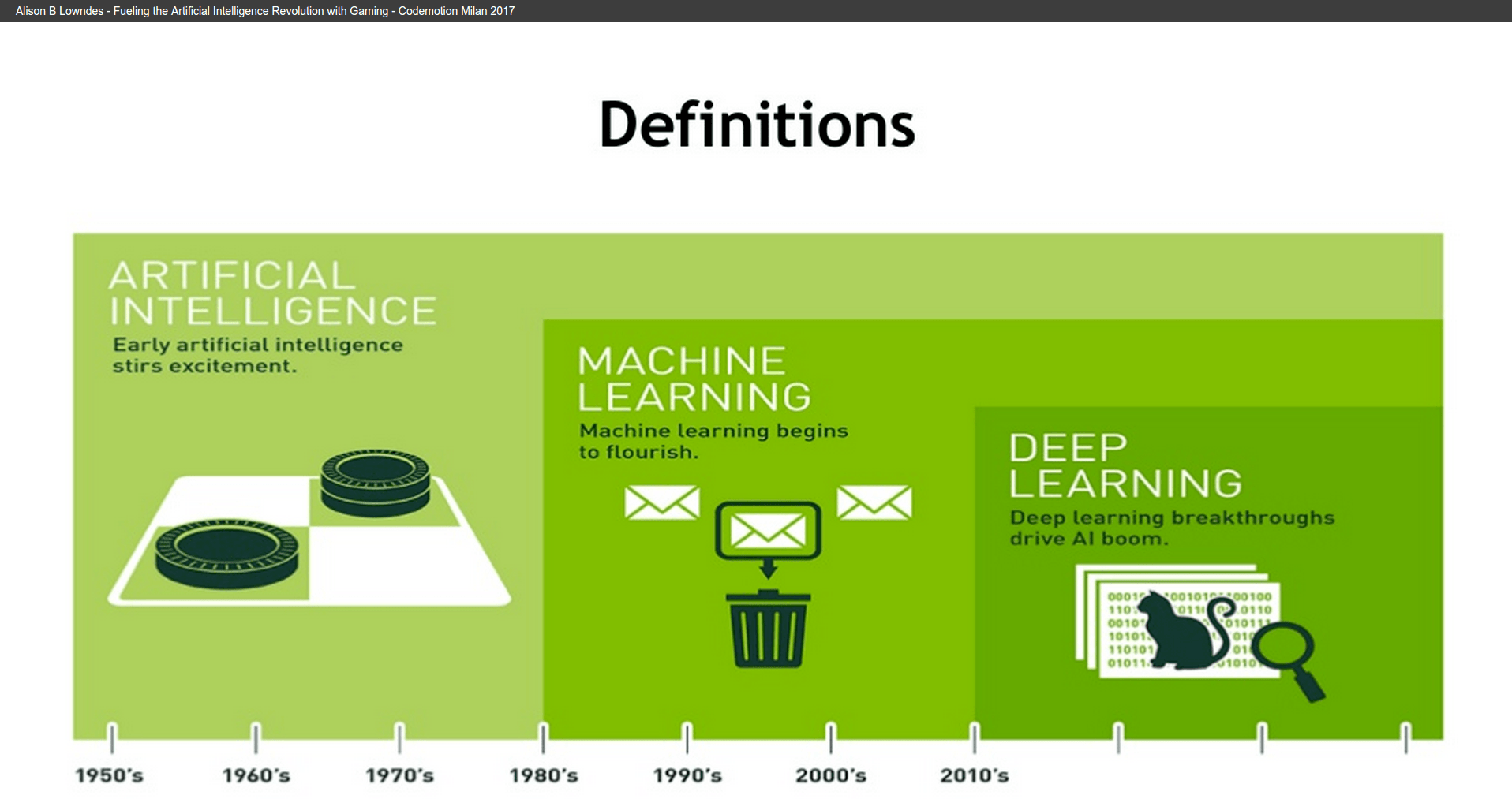
Essentially the year before, a similar disruptive force was just starting to build strength. I’m a massive fan of Feynman. I studied a bit of physics and Feynman. this is a Feynman diagram that basically shows the coming together of the GPU. All the data that we’re providing as a society which is key and the other integral which is the existing algorithms that we already had. It’s really important to understand the the definitions. You hear a whole load of hype about AI and a lot of it, thanks to the movies, is not true. We don’t have terminators yet but it’s really important that you understand so AI actually inlogic and rule-based learning as well as machine learning. Machine learning itself is this subset of deep learning. Deep just means it’s got more than two hidden layers. There’s a few other intricacies but they are related but they’re definitely not equivalent.


Neural Networks
The timeline here is really important as well this is not new technology basically it started in 1956. It’s something called the Dartmouth conference where it was Claude Shannon and a group of friends that put together this term artificial intelligence. They actually thought that they could probably solve it that summer as well but here we are now. If you don’t know the GPU the graphics processing unit which is NVIDIAs lifeblood is a coprocessor you still need the CPU. You’re just passing on the actual part of code that can be parallelized. We even have things called open ACC where you can literally shunt the parallelized sections, for example existing legacy code and then this leaves and frees up the CPU to take on its it’s typical serial jobs and running os’s etc.


CUDA
I don’t have time to actually go into the the intricacies of CUDA but we’ve got a stack of resources online and we run a very technical blog. CUDA itself is at the heart of AI because it’s at the heart of our room GPUs. Even Intel, if you look at some of the publicity that’s going around today it seems to be pivoting that way. Without guys and girls like you people reading the industry has no chance whatsoever in harnessing AI so again take a further look. Take some more courses and pivot towards this because AI is now central even to the people who don’t know it yet. To every single business that is out there today it’s probably the most profound thing since the transistor was invented. There is a whole lot that can that can happen and what you have to realize is that once you actually get the hang of deep learning or AI or any of the hype terms, that you’re here, this will actually help you in your job.


It’s about getting great coders into the workplace and also letting you sort of run free. AI is going to take a lot of the laborious tasks away from us and allow us lots and lots of time to to play in sandbox areas. To even break things and do what humans do really well which is get creative. When you start getting creative in code you can do some incredible things. I’m going to do a quick 101 on deep learning for those that actually don’t know it, so try and think about the differences between these two bikes so that’s my first-ever GSXR 750 on the left and this of course is the Ducati Monster.
What a computer will basically do is try and translate these images into pixels into maths into vectors and work out the actual differences on a pixel level. It will actually be able to capture things that we would never have thought about. It will pick up nuances about backgrounds. Like it has an aliens eyes that have been used to look at every single problem that humanity currently has. The problem that is to actually teach an AI system you have to have a large label data set for supervised learning and as far as I know we don’t yet have a data set like that.


I could go and perhaps create a million pictures of motorbikes off Google but then I would have to label each one. It was things like Stanford running the imagenet competition and the large part of that workload was actually labeling the data but I’m currently working with samasource. Samasource are literally pulling people out of slums in Kenya and India and teaching them how to help us provide these kind of data services like labeling data. It’s really quite profound so basically you’ve got things like like regression where you could take a million data points and and divide them up into a line but drawing that line through the data set you you still need something called a loss function. This measures how rubbish your system is at making a prediction and the key is to converge on a solution that’s acceptable. That’s to a certain level of accuracy and that depends on the actual applications themselves. Now the work course behind that is gradient descent.


Chris Ola of Google’s work, it’s a really cool way of reading papers and reading research papers is a really great way to actually keep up with this with this field. Take a look at this still so scary maths diagram but training a neural network is is all about trying to find a good minimum on an error. Surface deep learning systems, what they’re doing is they are just exploring through huge huge problem spaces and as humans we can’t cope with anything more than 3d maybe 4d and we’re at very very high dimensional capability here so we need AI to help us through this. To convert into maths and we need computers to actually do the computation and GPUs and they’re the workhorse they they take the brunt of it.


Deep Learning
Deep learning is split between two workloads. You have the computationally intensive training part, where although this is based on the on the brain itself, you’re in a supervised learning setup and feeding in lots and lots of labeled data. Once you actually got to a situation where you’ve actually trained and you’ve reached the end the accuracy that you want to get you have something called inference. An inference is basically just doing the forward path so you’re not doing forward backward and change the weights then repeating this process. You’re just doing the forward path so it’s very simple and this is how you can have it deployed on things like a mobile a mobile phone. Again I don’t have enough time to go deep into it but one thing you have to realize is that the world is not static. Images are great. Convolutional neural networks are very very good at working on static problems like like image recognition, but for everything else, which is dynamic, we need recurrent neural networks so things like speech recognition and pattern recognition in sequence looking at lots and lots of historical data.


Recurrent neural networks
Recurrent neural networks are really vital because they they grasp the structure of data dynamically over time. There were several problems with implementation but basically this was over 25 years ago and a guy named Sepp Hochreiter who was actually the first PhD of jurgen schmidhuber who is now director with a Swiss AI lab in Lugano Switzerland. Sepp Hochreiter solved the problem and he created something called long short-term memory, which is used throughout every kind of AI dynamic problem that you actually see today. I’m proud to know him and his team are also working on healthcare problems. They’re winning things like the tox 21 challenge where you can take deep learning and assess and how toxic various chemicals are to humans. Take a look at his paper from from it as it’s a really good one because it gives you an indication of the real understanding of deep learning and how networks represent layer by layer.


Otto Friedrich Karl Deiters (German: November 15, 1834 – December 5, 1863) was a German neuroanatomist. He was born in Bonn, studied at the University of Bonn, and spent most of his professional career in Bonn. He is remembered for his microscopic research of the brain and spinal cord.
Around 1860, Deiters provided the most comprehensive description of a nerve cell that was known to exist at the time. He identified the cells’ axon, which he called an “axis cylinder”, and its dendrites, which he referred to as protoplasmic processes. He postulated that dendrites must fuse to form a continuous network.
This diagram was drawn in 1865 by a guy called Otto Dieters and it’s showing the human nerve cell body. There and all the synapses and dendrites that actually come off. There is a huge body of work now that is mapping together neuroscience and AI. Geoff Hinton considered one of the godfathers of AI who’s actually bristol born but now he’s in montreal. They’re changing the way that that we use layers instead of just multi layer they’re putting layers within layers and this basically allows you to to map a whole lot of more data. More information at a cellular level and again i don’t have time to get into this but this is the really key thing whatever the architecture that you are using, convolutional, neural networks, recurrent, etc. The real power comes from these AI systems. There is nothing more powerful than a human being that’s assisted or augmented by AI. I prefer the term augmented intelligence than artificial intelligence because what it does is it brings us to to what I consider the next stage.


Reinforcement learning
The software is reinforcement learning or the theory is reinforcement learning. The hardware is both the GPUs that are running this and the CPUs but also what we’re deploying into which is robotics of varying shapes and forms both physical and virtual. So everybody has heard about alphago. This was reinforcement which combined dynamic programming and also supervised learning. Alphago zero now doesn’t even need that supervised learning part. It made a lot of headlines by saying that it was doing everything itself. Now when you actually go behind the scenes it couldn’t do anything without coders like you. Whether or not you’re working for Google, it makes no difference without the coders. Reinforcement learning basically is about learning a policy or the best next move to make, and this is across the board and but the key thing is that alphago zero whether it’s doing it entirely on its own or not still can’t play knots and crosses. It can’t play anything other than go so what they needed to do and this was a huge engineering effort.


Deep mind have their own deep mind lab. They needed to provide an environment where the AI agents could actually learn generalization. They could learn to play lots of other different games at the same time and games engines provide an infinite amount of training data. Deep minds latest work is where and I actually learned the word parkour. I’d never heard of the word parkour before but basically it is being able to do lots and lots of different actions like jumping running etc. It’s doing all this by itself. It’s actually learning to do the running and the jumping without any prior instructions whatsoever.
Imitation Learning
Imitation learning is another thing so this is where you you show a robot how to do something only once and this of course is getting close to how we learn. You need to see it twice or three times but ultimately we don’t need to see something a thousand times to actually do it. A researcher Berkeley left and along with them some other people he’s formed a company called embodied intelligence where he literally wants to work on just this. Since then this field has just exploded. I know because I kind of live right in the middle of everything and it’s part of my job to try and cover the research and and stay up with the actual progress. It’s drug design, it’s it’s astronomy, it’s use cases all over the place. I don’t have time as much as I would love to, to go into every single use case. Just in health care alone there is a plethora and there’s some really impactful work going on by harnessing AI. Deep Learning Toolkit (DLTK) is by Imperial College and it’s just a really great toolkit if you are working in the medical space.
This is Jamie by a company called Soul machines, founded by Mark Sagar. He’s responsible for avatar and the technology behind that and also won Oscars for King Kong. What he basically did was he got Cate Blanchett on board and recorded lots and lots of her dialogue and they’ve coupled together with a huge health insurance company in Australia to create this avatar that individuals can use. The Avatar talks to you just the same as Siri would but its actually got a face. She can actually read and understand emotion in voices. It’s an ongoing learning cycle as I’ve got the the the Samsung here, called their assistant Bixby and it tells you over and over again that it’s still learning. The more I use it the better it will be but there we go.


Even unity3d now has an AI lab and here’s a tip. Take a look dopamine games because they’re doing some very very cool stuff considering they’re actually on the smaller end of games out games houses. EAS CEO Andrew Wilson was was recently talking about the fact of feeding an AI system every acting performance in all war films we’ve ever had. Feed that into the actual system. How much is that going to improve the game? how much is it going to improve your experience? Putting AI into characters as well. The game studio respawn is responsible for things like titanfall, so you’re going to start to see AI in those games very very shortly and of course we’re all over this. We have been for quite a few years. We recently launched holo deck simply because we’re already doing lots of work in rendering photorealistic levels. We’re already talking to the car manufacturers and we’ve already been working with them for decades. This is about being able to get together with your collaborators wherever they are in the world put on a VR headset and you’re there with a full res setup of whatever you’re actually working on. This is a supercar that we actually demoed but built on built on the back of this is is Isaac. Isaac is a robotics learning platform that incorporates reinforcement learning as well as any robot that you want to put in there.


In 2013 I was working with the National Nuclear laboratory and we were coding a virtual robot. Controlling it with just an Xbox controller. So you can bring anything into this platform, teach it, get a trained system and then deploy it in a real robot. This is just a screenshot of Isaac in the nursery that we built within the holo deck and in there it can actually interact with you and play Domino’s and learn from you all using reinforcement learning. We’re only just scraping the surface here. We’re only in beta access but there are so many different opportunities here and of course the ultimate robot which we’ve been working on for quite a few years. Although this is a slightly different problem set because of course you’re talking about collision avoidance. With robots it’s all about touch, grasp and and haptics. The problem with this is the rest of the world that is so complex that we literally had to put together a whole new chipset. We put this together on various iterations starting with Drive px2 and and then we went to Xavier on the actual chipset.


The Pegasus chip is now capable of 320 Tflops, that’s trillion operations per second. It’s capable of perceiving the world through high res. It’s capable of 360 degree surround cameras localizing the the actual vehicle within centimeter accuracy but this is such a huge problem space that we want to see the fastest possible adoption of AI technology. We can’t address everything so we open-source the actual deep learning accelerator part of this chipset. We’re also right across the high-performance computing scenario and to prove that we have over 500 GPU ready apps. You can actually go to look at them and I don’t have time to list those 500 but it’s across each of those verticals in the slide right at the beginning.


Just to give you an indication now of how we enable people, all our software is free. You simply just go online to developer NVIDIA .com and we work with every single framework so the frameworks are basically the building blocks. They’re the way of, literally in some cases in natural language, creating the layers of the neural network that you’re going to use in code. There are over 60 different frameworks but there’s probably a top ten. We work with as many as we possibly can. I don’t really want to recommend but cafe 2 is really rocking well at the moment. I personally started in torch so PI torch of course is a big favorite of mine. We work with all the teams directly. Apache and Amazon are widely used and so they’re really good if you’re looking for which framework out of those 60-odd. There’s lots of information online but basically all our software is free just go to developer.android.com and sign up. To actually gain from CUDA, the programming language for the GPU (launched it in in 2006) this is exactly why you’re seeing a revolution in AI now. It’s because people are able to program the GPUs.


Deep Learning Frameworks

Caffe2
Caffe2 is a deep-learning framework designed to easily express all model types, for example, CNN, RNN, and more, in a friendly python-based API, and execute them using a highly efficiently C++ and CUDA back-end. Users have flexibility to assemble their model using combinations of high-level and expressive operations in python allowing for easy visualization, or serializing the created model and directly using the underlying C++ implementation. Caffe2 supports single and multi-GPU execution, along with support for multi-node execution.

Cognitive ToolkitThe Microsoft Cognitive Toolkit, formerly known as CNTK, is a unified deep-learning toolkit that describes neural networks as a series of computational steps via a directed graph. In this directed graph, leaf nodes represent input values or network parameters, while other nodes represent matrix operations upon their inputs.

MATLABMATLAB makes deep learning easy for engineers, scientists and domain experts. With tools and functions for managing and labeling large data sets, MATLAB also offers specialized toolboxes for working with machine learning, neural networks, computer vision, and automated driving. With just a few lines of code, MATLAB lets you create and visualize models, and deploy models to servers and embedded devices without being an expert. MATLAB also enables users to generate high-performance CUDA code for deep learning and vision applications automatically from MATLAB code.

MXNetMXNet is a deep learning framework designed for both efficiency and flexibility. It allows you to mix the flavors of symbolic programming and imperative programming to maximize efficiency and productivity.In its core is a dynamic dependency scheduler that automatically parallelizes both symbolic and imperative operations on the fly. A graph optimization layer on top of that makes symbolic execution fast and memory efficient. The library is portable and lightweight, and it scales to multiple GPUs and multiple machines.

NVIDIA CaffeCaffe is developed by the Berkeley Vision and Learning Center (BVLC) and by community contributors. NVIDIA Caffe, also known as NVCaffe, is an NVIDIA-maintained fork of BVLC Caffe tuned for NVIDIA GPUs, particularly in multi-GPU configurations.

PyTorchPyTorch is a Python package that provides two high-level features:Tensor computation (like numpy) with strong GPU accelerationDeep Neural Networks built on a tape-based autograd systemYou can reuse your favorite Python packages such as numpy, scipy and Cython to extend PyTorch when needed.

TensorFlowTensorFlow is an open source software library for numerical computation using data flow graphs. Nodes in the graph represent mathematical operations, while the graph edges represent the multidimensional data arrays (tensors) that flow between them. This flexible architecture lets you deploy computation to one or more CPUs or GPUs in a desktop, server, or mobile device without rewriting code. For visualizing TensorFlow results, TensorFlow offers TensorBoard, suite of visualization tools.

ChainerChainer is a Python-based deep learning framework aiming at flexibility. It provides automatic differentiation APIs based on the define-by-run approach, also known as dynamic computational graphs, as well as object-oriented high-level APIs to build and train neural networks. It supports CUDA and cuDNN using CuPy for high performance training and inference.

PaddlePaddlePaddlePaddle provides an intuitive and flexible interface for loading data and specifying model structures. It supports CNN, RNN, multiple variants and configures complicated deep models easily.It also provides extremely optimized operations, memory recycling, and network communication. PaddlePaddle makes it easy to scale heterogeneous computing resources and storage to accelerate the training process.
NVIDIA Deep Learning SDK
The NVIDIA Deep Learning SDK provides powerful tools and libraries for designing and deploying GPU-accelerated deep learning applications. It includes libraries for deep learning primitives, inference, video analytics, linear algebra, sparse matrices, and multi-GPU communications.


Graph analytics is across the board on many massive problem sets. So we’ve sped all that up with with MV graph and a visualization tool. When I was doing research in University I was just command-line and getting all my input from the from the very good output that’s given from torch and but then digits came along and you get to see exactly what’s going on in the actual layers. You get a visualization. You get a graphical understanding of the of the accuracy and how the loss is going. There’s also now a ton of pre trained models for data curation in the problem set. This is actually the majority of the work. It’s like 70% of the work. The AI side, you can just pick a pre-trained model and the job is done so as I said tensor RT is is for vastly faster inference.


Deep stream is for if you do an intelligent video analysis and a lot of people are. On the hardware side we are spending literally billions to actually get the best that we possibly can. The recent launch, which was Walter, is 21 billion transistors. We are at the limit now. We are right at the edge of what is possible. What we’ve had to do is is make fine tunings right down at the instruction set to actually provide even more speed up. When you’re talking about using tensor RT these are the differences in just up from just our previous chip which was Pascal.


AlexNet which is which is a type of convolutional neural network is a lot bigger now so it creates a lot more demand. The tensor core as I said has this brand new instruction set. AI is pretty much just matrix multiplication and accumulate or summation. That is really at the heart of it so what we did is we we managed to do the 4 by 4 multiply simultaneously and that in itself gives you 12 times the actual throughput already. The the tensor cores are part so there’s actually 640 of them with the over 5,000 cores that are now on our voltage chips. All that sounds great but how do you actually really cope with with massive problems? What we do is we put multiple cards into one unit. The dgx family was actually launched back in 2016 and this is eight high-end cards with our own interconnects because PCIe just doesn’t cut it anymore. We have our own interconnect called MV link.


We’ve containerized all that software I’ve spent the hours and hours trying to get all the dependencies together to actually do deep learning work. We’ve put it all now inside containers optimized to all the major frameworks and onboard dgx. It’s now Volta and what’s really important is that the software is optimized. You simply login to the system. It’s actually designed to do tasks very quickly. Pascal is a hundred and seventy teraflops so trillion floating point operations and voltages just blown that out of the window.
This is addressing the simple fact that there are teams of people who are now working on these problems and so it’s the ability with containers. At the moment it’s docker but we are looking at all the other use cases because the HPC will prefer things like singularity. Kubernetes is is very popular so we’re looking at all that and we’re implementing it as fast as we can. Dgx is actually a server so obviously it needs to be rack mounted if you don’t have that capability you can actually now get a desk side version with Volta. This is actually for cards, it’s water-cooled so it’s nice and quiet. Dgx the server is not quiet because you’ve got eight massive cards doing a lot of work.


Alternatively you can now access Walter right now via Amazon Web Services up in the cloud. We have something called NGC or the NVIDIA GPU cloud where you have the the capability in three simple steps to sign up. You can either choose to use the cloud or choose to use local compute. If you’ve got some of our geforce cards or you have dgx and then you simply just pull one of these containers down. We have an entire registry of containers now for all of the of the frameworks. All other possible combinations and versions of Cuda etc but the the the real key here is everything’s up to date. There’s no more going through the whole rigmarole. You’d simply just just click on that up-to-date container and it really just makes life a lot easier. We build the products for training things like dgx and we build the products for inferencing. That’s in the data center like our Tesla cards.

There is this other part and that’s inference and this is this is huge. I mean this is in billions of cameras, billions of edge devices. We actually have no idea how big this problem is going to be but we have to address it now. This is just some of the actual use cases that we’re dealing with on on a daily basis. So of course we need an embedded GPU and we have a credit card size GPU called Jetson now tx2. The version that is capable of between one and one and a half trillion floating point operations per second in a credit card space and there’s lots and lots of people using this for various use cases. You can actually buy it very cheaply in a dev kit formats. Its got loads of IO, it’s got a camera on board, or if you’re in academic we actually give them away with an entire robotics and embedded teaching kit alongside.


TX 2 Development Kit
So we have these these teaching kits that we’ve worked with NYU and young laocoon as well specifically for deep learning. Servo city work with us on on these teaching kits. There is this entire embedded space. There’s $11,000 Nvidia but that’s not a big enough market so we have to put the entire embedded space online. That means you can get every single piece of information and the hardware purely via the website. Including jetpack and if I wrote another article that would not be enough to tell you all about the the various parts of jet pack and what it can do. Everything that we try to do is is so that you can develop and deploy right across the same architecture. That’s hardware architecture with the same software that you’ve been using and prototyping on.
We do so much training now that we developed something called the deep learning Institute and this is using ipython or Jupiter notebooks so you can do hands-on coding on our GPUs in Amazon Web Services right now. We also work with Microsoft Azure and our GPUs are in every cloud provider that there is so this will eventually branch out. We have over 200 different classes you can go online to that website now and do at least three of those for free. Hands-on coding in an in a variety of different frameworks. You just go on to a setup called quick labs which was actually bought by Google. Google’s entire cloud platform is going to be accessible via quick labs.
About 200 different use cases and there’s there’s a few that are actually free for you to have a go at and there you can actually get down into the actual code and work with code and start to understand it. If you’re actually thinking of setting up a start up then please just do a very quick sign up to NVIDIAs inception program where we can actually give you a ton of support and big discounts to hardware and of course all the software. I just want to leave you with the fact that we are hiring massively right now if you have any kind of deep learning machine learning skills or just the ninja coder please contact NVIDIA.
True Artificial Intelligence Will Change Everything
Posted on July 25th, 2018

Jürgen Schmidhuber (born 17 January 1963) is a Computer Scientist who works in the field of AI. He is a co-director of the Dalle Molle Institute for Artificial Intelligence Research in Manno, in the district of Lugano, in Ticino in southern Switzerland.Schmidhuber did his undergraduate studies at the Technische Universität München in Munich, Germany. He taught there from 2004 until 2009 when he became a professor of artificial intelligence at the Università della Svizzera Italiana in Lugano, Switzerland.
When I was a boy I wanted to maximize my impact on the world. I was smart enough to realize that I am NOT very smart. That I have to build a machine that learns to become much smarter than myself, such that it can solve all the problems that I cannot solve myself. Then I can retire and my first publication on that dates back 30 years. My 1987 diploma thesis where I already try to solve the grand problem of AI not only build a machine that learns a little bit here and there but also learns to improve the learning algorithm itself. The way it learns, recursively without any limits except the limits of logic and physics.


I’m still working on the same old thing and I’m still pretty much saying the same thing except that now more people are listening. The learning algorithms that we have developed on the way to this goal are now on three thousand million smartphones and all of you have them in your pockets. What you see here are the five most valuable companies of the Western world Apple Google Facebook Microsoft and Amazon and all of them are emphasizing that AI artificial intelligence is central to what they are doing. All of them are using heavily the deep learning methods that my team has developed since the early nineties.


Have you ever heard of the long short-term memory?
The LSTM is a little bit like your brain it’s an artificial neural network which also has neurons. In your brain you’ve got about 100 billion neurons and each of them is connected to roughly 10,000 other neurons on average which means that you have got a million billion connections. Each of these connections has a strength which says how much does this neuron over here influence that neuron over there at the next time step. In the beginning all these connections are random and the system knows nothing within. Through a smart learning algorithm it learns from lots of examples to translate the incoming data such as video through the cameras or audio through the microphones or pain signals through the pain sensors. It learns to translate that into output actions because some of these neurons are output neurons that control speech muscles and finger muscles and, through experience only, it can learn to solve all kinds of interesting problems.


Problems such as driving a car or to do the speech recognition on your smartphone, because whenever you take out your smartphone an Android phone for example, and you speak to it and you say ok Google show me the shortest way to Milano then it understands your speech because there is an LSTM in there which has learned to understand speech. Every 10 milliseconds, 100 times a second, new inputs are coming from the microphone and then translates it, after thinking, into letters which is then sent as a question to the search engine.


The basic LSTM cell looks like this.
By listening to lots of speech since 2015 Google speech recognition is now much better than it used to be.
I can list the names of the brilliant students in my lab who made that possible and what are the big companies doing with that speech recognition. As an example if you are on Facebook, I use click at the translate button because somebody sent something in a foreign language and then you can translate it. When you do that you are waking up a long short term memory and LSTM which has learned to translate text in one language into translated text and Facebook is doing that four billion times a day. Every second, 50,000 sentences are being translated by an LSTM working for Facebook and another 50,000 in the second and another 50,000 so see how much this thing is now permitting in the modern world.


Just note that almost 30 percent of the awesome computational power of all these Google Data Centers all over the world is used for LSTM. If you have an Amazon echo you can ask it questions it answers you and the voice that you hear it’s not a recording it’s an LSTM network which has learned from training examples to sound like a female voice. If you have an iPhone and you’re using quick type it’s trying to predict what you want to do next given the previous context of what you did so far. Again that’s an LSTM which has to do that so it’s on a billion iPhones.


When we started this work decades ago in the early 90s only a few people were interested because computers were so slow and you couldn’t do so much with them. I remember I gave a talk at a conference and there was just one single person in the audience a young lady. I said young lady it’s very embarrassing but apparently today I’m going to give this talk just to you and she said okay but please hurry I am the next speaker. Since then we have greatly profited from the fact that every five years computers are ten times cheaper. This is an old trend that has held since 1941 at least since this man Conrad Susan built the first working program control computer in Berlin. He could could do roughly one operation per second one and then ten years later for the same price one could do 100 operations. 30 years later 1 million operations were the same price and today after 75 years we can do a million billion times as much for the same price. The trend is not about to stop because the physical limits are much further out there. Rather soon and not so many years or decades away we will for the first time have little computational devices that can compute as much as a human brain. 50 years later there will be a little computational device for the same price that can compute as much as all 10 billion human brains taken together and there will not only be one of those devices but very many.


Everything is going to change. In 2011 computers were fast enough such that our deep learning methods for the first time could achieve a superhuman pattern-recognition result. The first superhuman result in the history of computer vision. Back then computers were 20 times more expensive than today. Today for the same price we can do 20 times as much and just five years ago when computers were 10 times more expensive than today we already could win for the first time medical imaging competitions. What you see above is a slice through the female breast and the tissue that you see there has all kinds of cells and normally you need a trained doctor a trained who is able to detect the dangerous cancer cells or pre-cancer cells. Now our stupid network knows nothing about cancer, knows nothing about vision, it knows nothing in the beginning but we can train it to imitate the human teacher. It became as good as or better than the best competitors and very soon all of medical diagnosis is going to be superhuman. It’s going to be mandatory because it’s going to be so much better than the doctors. After this all kinds of medical imaging startups were founded focusing just on this because it’s so important.


We can also use LSTM to train robots. One important thing I want to say is that we not only have systems that slavishly imitate what humans show them. We also have AI’s that set themselves their own goals and like little babies invent their own experiment to explore the world and to figure out what you can do in the world without a teacher. Becoming more and more general problem solvers in the process by learning new skills on top of old skills. This is going to scale well. Learning to invent like a scientist. I think in not so many years from now for the first time we are going to have an animal like AI. You don’t have that yet. On the level of a little monkey and once we have that it may take just a few decades to do the final step towards human level intelligence. Technological evolution is about a million times faster than biological evolution and biological evolution needed 3.5 billion years to evolve a monkey from scratch but then just a few tens of millions of years afterwards to evolve human level intelligence.


We have a company which is trying to make this a reality and build the first true general and purpose AI. At the moment almost all research in AI is very human centric and it’s all about making human lives longer and healthier and easier and making humans more addicted to their smartphones. In the long run AI’s, especially the smart ones, are going to set themselves their own goals and I have no doubt in my mind that they are going to become much smarter than we are. They are going to realize what we have realized a long time ago namely that most of the resources in the solar system or in general are not in our little biosphere. They are out there in space and so of course they are going to emigrate and of course they are going to use trillions of self-replicating robot factories to expand in form of growing AI bubble which within a few hundred thousand years is going to cover the entire galaxy.


What we are witnessing now is much more than just another Industrial Revolution this is something that transcends humankind and even life itself. The last time something so important has happened was maybe 3.5 billion years ago when life was invented. A new type of life is going to emerge from our little planet and it’s going to colonize and transform the entire universe. The universe is still young it’s only 13.8 billion years old. It’s going to become much older than that. Many times older than that. So there’s plenty of time to reach all of it or all of the visible parts totally within the limits of light speed and physics. A new type of life is going to make the universe intelligent. Now of course we are not going to remain the crown of creation, of course not, but there is still beauty in seeing yourself as part of a grander process that leads the cosmos from low complexity towards higher complexity. It’s a privilege to live at a time where we can witness the beginnings of that and where we can contribute something to that.
Machine learning predicts World Cup winner
Posted on July 21st, 2018
This AI Simulated the 2018 World Cup 100,000 Times to Predict a Winner
A group of researchers used AI and machine learning to predict that Spain and Germany are the most likely winners of the 2018 World Cup in Russia.

The 2018 soccer World Cup kicks off in Russia on Thursday and is likely to be one of the most widely viewed sporting events in history, more popular even than the Olympics. So the potential winners are of significant interest.One way to gauge likely outcomes is to look at bookmakers’ odds. These companies use professional statisticians to analyze extensive databases of results in a way that quantifies the probability of different outcomes of any possible match. In this way, bookmakers can offer odds on all the games that will kick off in the next few weeks, as well as odds on potential winners.An even better estimate comes from combining the odds from lots of different bookmakers. This approach suggests Brazil is the clear favorite to win the 2018 World Cup, with a probability of 16.6 percent, followed by Germany (12.8 percent) and Spain (12.5 percent).But in recent years, researchers have developed machine-learning techniques that have the potential to outperform conventional statistical approaches. What do these new techniques predict as the likely outcome of the 2018 World Cup?An answer comes from the work of Andreas Groll at the Technical University of Dortmund in Germany and a few colleagues. These guys use a combination of machine learning and conventional statistics, a method called a random-forest approach, to identify a different most likely winner.

First some background. The random-forest technique has emerged in recent years as a powerful way to analyze large data sets while avoiding some of the pitfalls of other data-mining methods. It is based on the idea that some future event can be determined by a decision tree in which an outcome is calculated at each branch by reference to a set of training data.However, decision trees suffer from a well-known problem. In the latter stages of the branching process, decisions can become severely distorted by training data that is sparse and prone to huge variation at this kind of resolution, a problem known as overfitting.The random-forest approach is different. Instead of calculating the outcome at every branch, the process calculates the outcome of random branches. And it does this many times, each time with a different set of randomly selected branches. The final result is the average of all these randomly constructed decision trees.This approach has significant advantages. First, it does not suffer from the same overfitting problem that plagues ordinary decision trees. It also reveals which factors are most important in determining the outcome.So if a particular decision tree includes lots of parameters, it becomes easy to see which ones have the biggest impact on the outcome and which do not. These less important factors can then be ignored in future.Groll and co use exactly this approach to model the 2018 World Cup. They model the outcome of each game the teams are likely to play and use the results to construct the most probable course of the tournament.Groll and co begin with a wide range of potential factors that might determine the outcome. These include economic factors such as a country’s GDP and population, FIFA’s ranking of national teams, and the properties of the teams themselves, such as their average age, the number of Champions League players they have, whether they have home advantage, and so on.Interestingly, the random-forest approach allows Groll and co to include other ranking attempts, such as the rankings used by bookmakers.Plugging all this into the model provides some interesting insights. For example, the most influential factors turn out to be the team rankings created by other methods, including those from bookmakers, FIFA, and others.

Other important factors include GDP and the number of Champions League players on the team. Unimportant factors include the country’s population, the nationality of the coach, and so on.The predictions arrived at through this process differ from others in some important ways. For a start, the random-forest method picks out Spain as the most likely winner, with a probability of 17.8 percent.However, a big factor in this prediction is the structure of the tournament itself. If Germany clears the group phase of the competition, it is more likely to face strong opposition in the 16-team knockout phase. Because of this, the random-forest method calculates Germany’s chances of reaching the quarter-finals as 58 percent. By contrast, Spain is unlikely to face strong opposition in the final 16 and so has a 73 percent chance of reaching the quarter-finals.If both make the quarter-finals, they have a more or less equal chance of winning. “Spain is slightly favored over Germany mainly due to the fact that Germany has a comparatively high chance to drop out in the round-of-sixteen,” say Groll and co.But there is an additional twist. The random-tree process makes it possible to simulate the entire tournament, and this produces a different result.

Groll and co simulated the entire tournament 100,000 times. “According to the most probable tournament course, instead of the Spanish the German team would win the World Cup,” they say.Of course, because of the huge number of permutations of games, this course is still extremely unlikely. Groll and co put the odds at about 1 in 100,000.So there you have it. At the beginning of the tournament, Spain has the best chances of winning, according to Groll and co. But if Germany makes the quarter-finals, it then becomes the front-runner.The tournament kicks off on Thursday, when the hosts, Russia, take on Saudi Arabia. Sadly, neither of these teams looks likely to make even the quarter-finals.Ref: arxiv.org/abs/1806.03208 : Prediction Of The FIFA World Cup 2018 – A Random Forest Approach With An Emphasis On Estimated Team Ability Parameters